
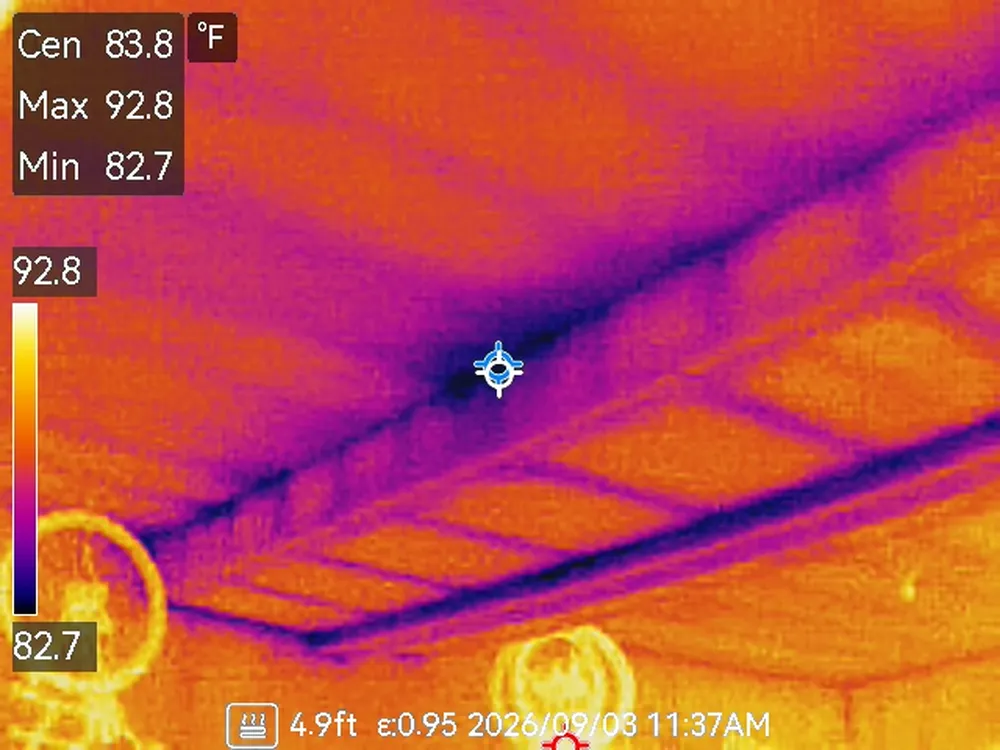
HOI Property Services inspects homes across Peoria and Central Illinois, and when mold shows up on a garage ceiling the first question is always where the water came from. On a recent inspection the answer was not the roof and not a plumbing leak — it was conditioned air escaping from a supply duct in the floor cavity above, and the thermal camera is what made the case.
The Mold Was Already Confirmed. The Cause Was Not.
A different mold inspector had tested this garage before my inspection, so nobody was debating whether the dark growth on the ceiling was real. What was still open was the question that actually costs money to get wrong: what kept that spot wet long enough for mold to take hold? Mold does not appear on a painted drywall ceiling for no reason. Something is feeding it moisture, and until you find that something you are just cleaning a stain.
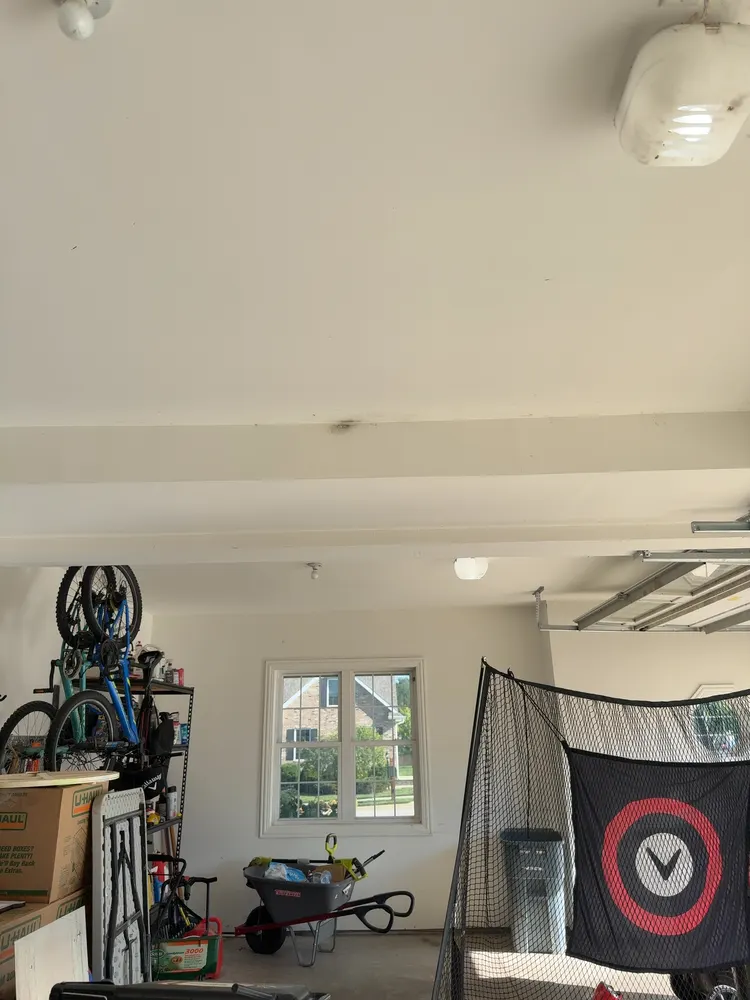
The growth sat where the ceiling meets a dropped beam, a few feet inside the overhead door.
Look at what is above that spot and what is not. There is no roof over it — this is the underside of a floor, with a bedroom on the second story. No plumbing runs through that bay. A roof leak or a failed supply line would have been the convenient answer, and neither one was available.
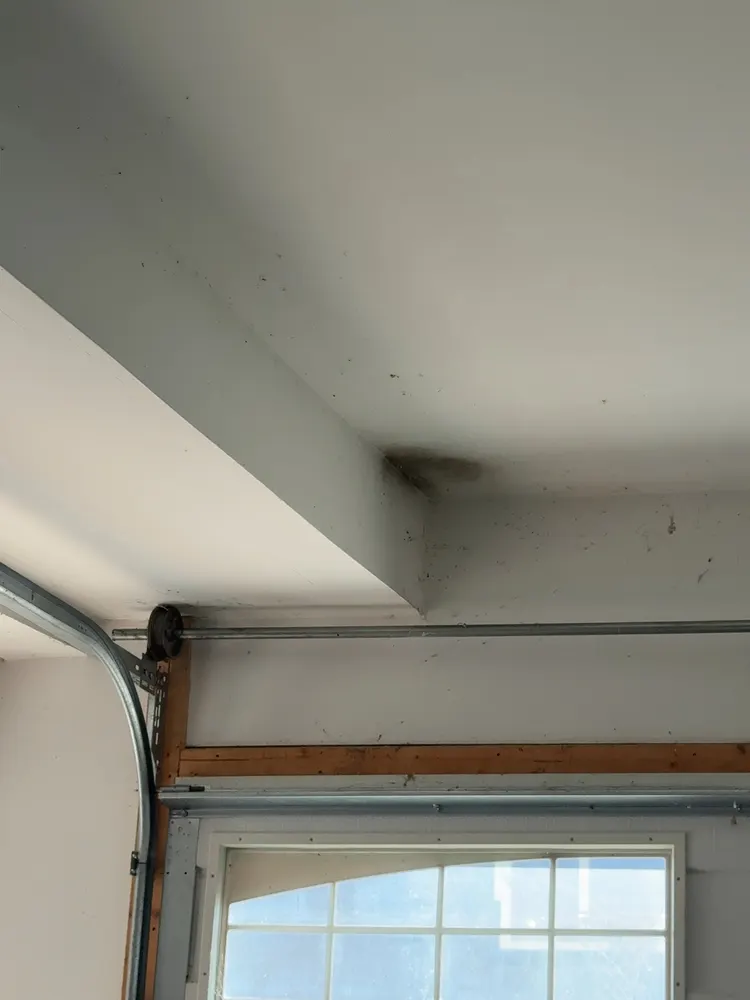
The wider view. One isolated spot on an otherwise clean ceiling — that pattern points to a single source.
The Location Was the First Clue
Directly above that growth, in the bedroom on the second floor, is a supply register. The duct feeding that register has to travel to get there, and in this house it runs through the floor cavity between the bedroom floor and the garage ceiling — the exact bay where the mold was growing. That is a coincidence worth taking seriously. It is not, by itself, a finding. I needed to see the air.
What the Thermal Camera Showed
An infrared camera does not see mold and it does not see moisture. What it sees is surface temperature, and temperature is what gives a hidden air leak away. Sweeping the garage ceiling, I did not get the even reading you would expect from painted drywall on a warm September day. I got a distinct cold streak running down the ceiling and into the corner where the growth was.
In the image at the top of this post, the coldest surface in the frame read 82.7°F while the warmest surface in that same frame read 92.8°F — a ten-degree spread across a single ceiling that should have been uniform. The second scan, taken at the corner, showed the cold band tracking right into the junction of the beam and the exterior wall.
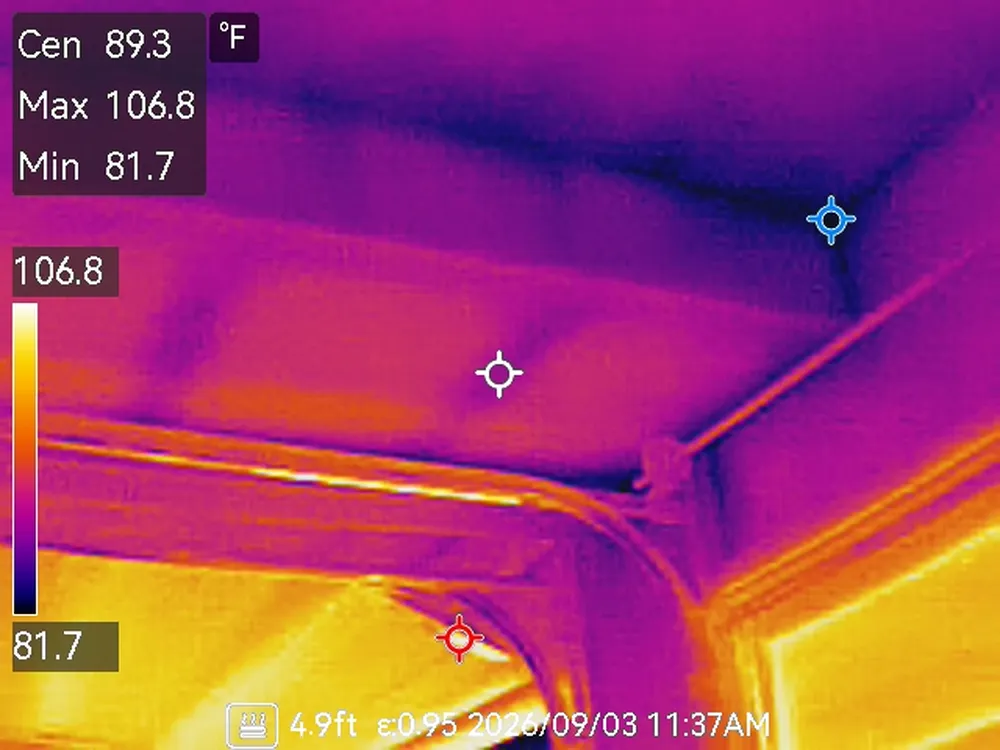
The same cold band at the corner. Cold air does not wander — it follows the duct.
That is the part that matters. A cold spot on a ceiling can be a lot of things: missing insulation, a draft, thermal bridging at framing. But this one had a shape, and the shape followed the path a supply duct takes to reach the register in the room above, ending in the same corner where the mold was.
Cold Air Plus Humid Garage Air Equals Water
Here is the chain of events. A supply duct carrying air-conditioned air develops a leak — a loose connection, a failed tape joint, a gap where the duct passes through framing. Instead of all of that cold air reaching the bedroom, some of it dumps into the enclosed floor cavity above the garage. The cavity gets cold. The drywall ceiling underneath it gets cold with it.
Meanwhile the garage is unconditioned. In an Illinois summer that means warm, humid air, refreshed with a new load of it every single time the overhead door goes up. Warm humid air meeting a cold surface gives up its moisture — the same reason a glass of ice water sweats on a July afternoon. One afternoon of that is nothing. Repeat it daily across a couple of cooling seasons on paper-faced drywall and you get exactly what this ceiling looked like.
There is a second cost most homeowners never connect to the stain. Every bit of conditioned air escaping into that cavity is air someone paid to cool and never received. If the bedroom over the garage has always been the room that will not hold temperature in August, a leaking supply duct is the kind of defect that explains it.
Fix the Cause, Not Just the Symptom
My recommendation was mold remediation with an HVAC evaluation of that duct run happening alongside it. The pairing is the point. Clean the ceiling without correcting the duct and you have only reset the clock — the surface goes cold again, the condensation comes back, and so does the growth. Correct the duct without addressing the growth and you have left material in the home that nobody wants there.
I also want to be straight about what this inspection did and did not establish. I did not open the ceiling. What I have is a thermal pattern consistent with escaping conditioned air, mold sitting in the same place that pattern terminates, and a supply register directly above it. That is enough to send a qualified HVAC contractor to the right bay with the right question instead of leaving a homeowner to guess. Confirming the leak point and correcting it is their work, not mine, and I say so in the report.
If You Have a Room Over the Garage
Look up when you walk into your garage. That ceiling is the underside of a living space and it is one of the few spots in a house where a hidden mechanical problem shows itself in plain view. Discoloration in one isolated area is worth a phone call.
Notice which room will not hold temperature. A bonus room or bedroom over the garage that runs hot in summer and cold in winter is telling you something about the duct that serves it.
Do not assume a stain means the roof. On a garage ceiling with living space above, the roof is not even a candidate. Plumbing, roof, and duct leaks all leave marks; only one of them is possible in that assembly.
Understand what a mold test does and does not tell you. Testing confirms what is present. It does not tell you why. Both answers matter, and mold evaluation is most useful when it comes with an explanation of the moisture source.
Why the Camera Comes on Every Inspection
Nothing about this find required specialty equipment beyond what I carry to every job. Thermal imaging is standard on every HOI inspection, not a paid add-on, because problems like this one are invisible to a flashlight and obvious to a camera. A visual inspection would have documented mold on a garage ceiling and recommended further evaluation. The camera turned that into a specific, actionable cause in about two minutes.
If you are buying a home with a room over the garage, or you have a spot on your own garage ceiling that you have been meaning to ask someone about, book an inspection online or call (309) 712-4189. I would rather find it now than have you find it later.