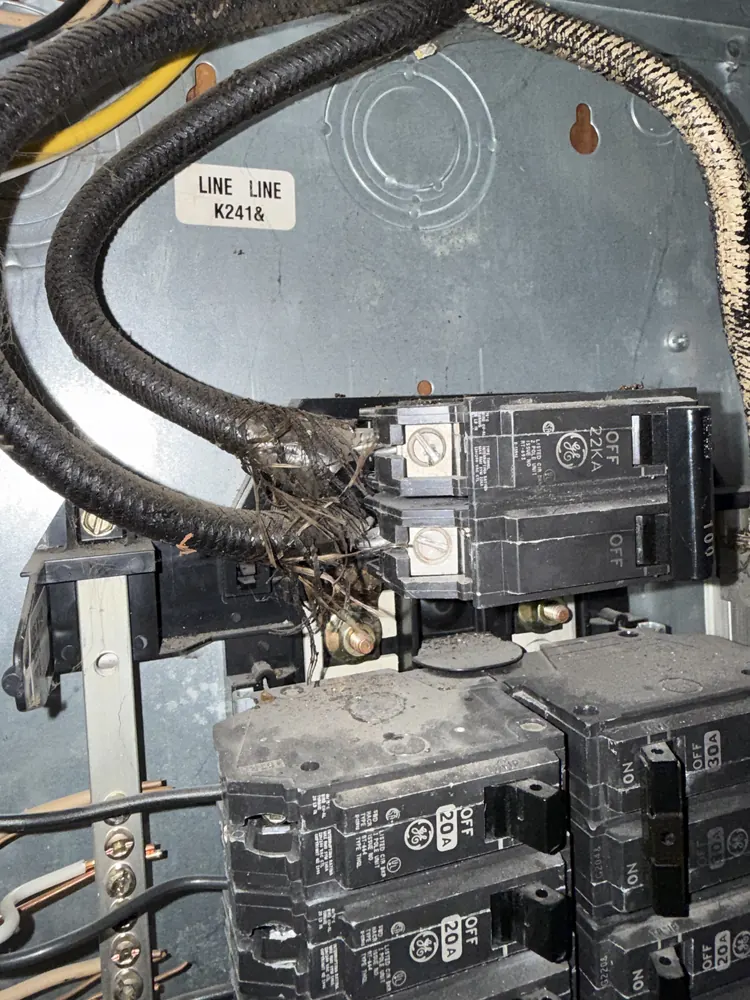
Cloth wiring is the fabric-braided wiring found in most Central Illinois homes built before about 1960, and on its own it is not a reason to walk away from a house. At HOI Property Services in Peoria, I find it almost every week. What matters is the condition it is in — and the panel in the photo above, from a 1950s home I inspected recently, is a good example of what I mean.
That home was wired in cloth throughout, which is exactly what I expected for its age. The part worth looking at twice is up at the top of the panel, where the fabric insulation on the conductors has dried out and frayed back to loose strands right at the main breaker.
What Cloth Wiring Actually Is
Before plastic-jacketed wire became standard, conductors were insulated with rubber and then wrapped in a woven cotton or fabric braid for protection. That braid is what people are pointing at when they say a house has "cloth wiring." It was ordinary, code-compliant construction in its day, and it was installed in tens of thousands of homes across Peoria, Pekin, Morton, Bloomington, and every other town in this part of the state during the postwar building boom.
Cloth wiring is not knob-and-tube, and the two get confused constantly. Knob-and-tube is an older system where individual conductors run separately through ceramic knobs and tubes, with no ground and no shared jacket. Cloth-wrapped cable is the generation that followed it. A house can have one, the other, or both, and they carry different concerns. If someone tells you your 1955 house has knob-and-tube because they saw fabric on the wire, get a second opinion.
What Actually Goes Wrong With It
The rubber underneath gets brittle: the fabric braid is the part you see, but the rubber insulation under it is what does the actual work. Rubber hardens and cracks as it ages, and heat accelerates it. That is why the worst deterioration almost always shows up where the wire has spent decades running warm — inside the panel, at the service conductors, and at fixtures.
The braid frays where it has been handled: every time someone opens a panel, adds a circuit, or moves a conductor, old fabric sheds a little more. Fifty years of that adds up to what you see in the photo: bare strands hanging off a conductor a couple of inches from a live lug.
Most of those circuits have no ground: homes of that era were wired with two conductors, hot and neutral, and no equipment grounding conductor. That is why you find two-prong outlets throughout. It is not a defect in the sense that it was wrong when it was built, but it does limit what you can safely plug in and it matters for anything with a metal case.
Someone has usually been in there since: in my experience, the real hazards in an old panel are rarely the original 1950s work. They are the additions — a circuit tapped in by a previous owner, a modern breaker crowded in next to old cloth conductors, an outlet swapped to three-prong with nothing behind it. The original wiring tends to be honest about its age. The modifications are what hide.
Some sheathing from that era contains asbestos: not all of it, and not in a way that is hazardous while it is sitting undisturbed inside a wall. It becomes relevant when someone starts cutting and pulling wire during a rewire, which is a reason to hire an electrician who knows what they are working with rather than a reason to panic.
What I Look At When I See It
I do not write up cloth wiring as a defect just because it is cloth. I write up what I can observe about its condition. I pull the panel cover and look at the conductors where they land, because that is where age and heat show first. I check whether outlets are two-prong or have been swapped to three-prong without a ground. I look for splices outside of boxes, for signs of overheating at connections, and for whatever additions have been made over the decades. I also run thermal imaging on every inspection, which is included standard, and a warm connection in a panel is one of the things it is genuinely good at surfacing.
The rest of the picture matters too: whether the panel is full, whether the service is adequate for how the house is actually used now, and whether anything is drawing more current than the original wiring was ever asked to carry. A 1950s circuit that ran a lamp and a radio is doing different work in a house full of modern loads.
What I Told This Client
I called it out as a budget item, not an emergency. Nothing in that panel was actively failing, there was no heat at the connections, and the house had been running on that wiring for seventy years without incident. Ripping out a working system on the day you buy a house is rarely the right move, and I am not going to tell a buyer to do that to make my report look thorough.
What I did tell them is that this is a system with a finite life that has already spent most of it. The deteriorated insulation at the top of the panel is worth having an electrician look at and address, and beyond that, cloth wiring is something to plan around rather than ignore. If they open up walls for a remodel, that is when you upgrade what is behind them. If they add significant load, that is when you re-evaluate the service. And when circuits start doing anything unusual — warm outlets, breakers tripping, lights flickering — that is not a quirk of an old house, that is information.
That is the honest version, and it is more useful than either extreme. Telling a buyer that cloth wiring is a crisis costs them a house they should have bought. Telling them it does not matter costs them later.
If You Already Own an Older Home
Have the panel opened and looked at by someone qualified, especially if you have never had it done. Most homeowners have no reason to ever see the inside of their own panel, and it is where the story is. If you have two-prong outlets and you have been using cheater plugs to get around them, stop — that removes the safety feature without adding the ground it is pretending to provide. And if an insurer asks you about your wiring, an inspection report describing its actual condition is worth considerably more than a guess about its age.
Getting a Straight Answer on Your Own House
If you are buying an older home in Peoria or anywhere in Central Illinois and you want to know what you are actually dealing with, a thorough home inspection should tell you the condition of the wiring, not just its vintage. I inspect the panel, the visible wiring, the outlets, and the connections, and you get the findings clearly and concisely in a report the same day.
To get on the schedule, book online or call (309) 712-4189. If you have an old panel and you are not sure what you are looking at, that is exactly the kind of question I like getting.